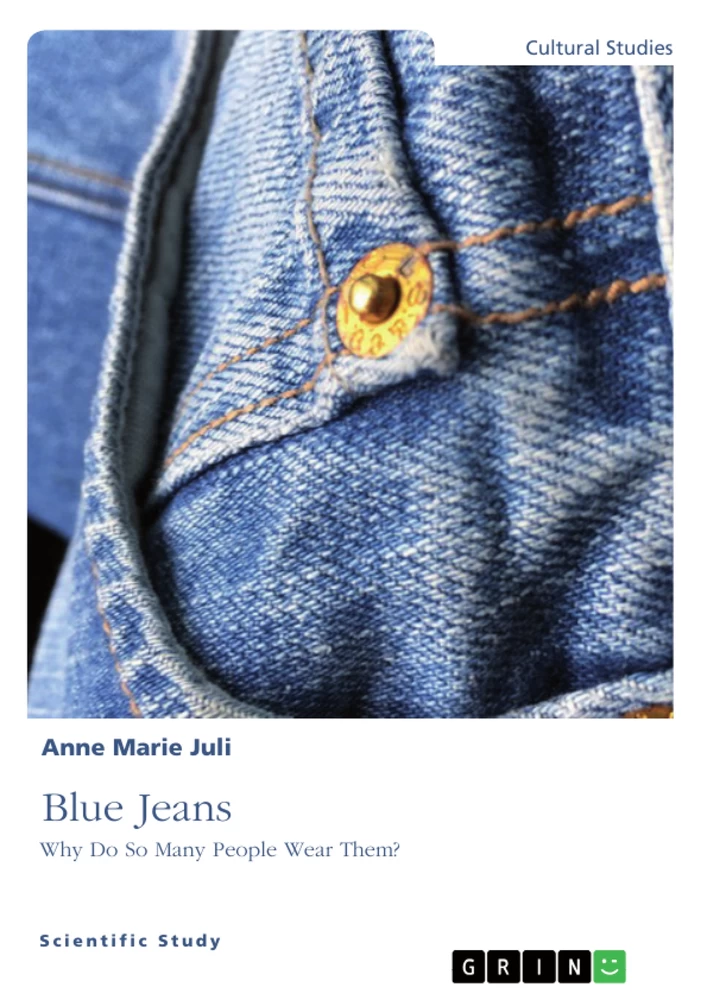
Blue jeans are a cultural and historical phenomenon. Patented exactly 150 years ago, they have developed from work trousers to a cult object and finally to a neutral mass-produced and disposable item.
Why do so many people wear blue jeans? What significance do they have for baby boomers and young adults? What do people associate with wearing these pants? How is it possible that blue jeans are still marketed as a fashion item?
Anne Marie Juli answers these and other questions in her book. The focus is on the paradoxical human need for cultural affiliation and individual distinction. This book is aimed at teachers and students of social and cultural sciences, fashion schools, employees in the textile industry and anyone who is concerned about the expression of the own identity.
Table of Contents
Foreword
Chapter 1 Introduction
Questions and Target Groups
Range
Structure
Chapter 2 Blue Jeans or Jeans? A Clarification of Terms
Denim and Raw Denim
Indigo(blue)
Chapter 3 Development of a Cultural-Historical Phenomenon
From Work to Leisure Pants
Movie Idols in Blue Jeans: Role Models for 1950s Teenagers
Blue Jeans - the Rebellious Pants?
Contemporary Witnesses
Blue Jeans for All Everywhere
Blue Jeans as Part of Subcultural 'Dress Codes'
Conclusions
Chapter 4 Blue Jeans as a Research Object
Theoretical Frame of Reference
Adaptation Versus Profiling
Individualization Versus Uniformization
Identity Versus Subcultural Context
Chapter 5 Research Design
Scientific Positioning
Triangulation
Mix of Methods
Tally Sheet Survey
Large Scale Survey
Guided Interviews
Chapter 6 Denim Uniformity in Public Spaces
Tally Sheet Survey
Blue Jeans Wearers in Osnabrück
Gender and Age
Blue Jeans and Dress Codes?
Social differences?
Conclusion
Chapter 7 What Makes Blue Jeans Popular?
The Survey
Who Wears Blue Jeans?
Reasons to Wear Blue Jeans
Blue Jeans Properties
Wearing Habits
Why Don't Some People Wear Blue Jeans?
Are Abstainers Less Adjusted than Blue Jeans Wearers?
Differences Between Generations?
Conclusion
Chapter 8 Blue Jeans for Individual Dress Style
Questions
An Individual Style of Dress?
Desired Appearance?
Basic Part of the Wardrobe
Stand out or blend in with the crowd?
Are 'Normals' More Adapted?
Nostalgia?
Do Blue Jeans Wearers Follow Fashion?
Conclusion
Chapter 9 Blue Jeans - The Fashionable Evergreen?
What is fashion?
Reasons for the fashion change: differentiation and imitation
Conclusion
Chapter 10 Blue Jeans - Uniform of an Individualized Society?
Individual freedom versus social constraints
Individualization and Uniformity in Clothing
Conclusion
Chapter 11 Blue Jeans - Product of Successful Advertising?
Advertising and Marketing
Advertising Expenditure and Sales Development in the Jeans Industry
Advertising Effectiveness
Blue Jeans in Advertising
Indirect Blue Jeans Advertising in "Brigitte”
Conclusion
Chapter 12 That's Why So Many People Wear Blue Jeans
Uniformization and Individualization
Blue Jeans and Fashion - About Adaptation and Profiling
Identity and Cultural Context
Conclusion and Outlook
Afterword
Literature
Appendix I Blue Jeans Typology
Appendix II Questionnaire for the Online Survey
Appendix III Questions for the Guideline Interviews
Appendix IV Blue Jeans in Brigitte Magazine
Objectives and Research Themes
This study aims to investigate the reasons for the pervasive popularity and resulting uniformity of blue jeans in Germany, despite the modern societal emphasis on individualization and self-actualization. The central research question explores how blue jeans moved from being a symbol of rebellion in the 1970s to a ubiquitous, "ordinary" item of clothing today, and whether this uniformity is a result of individual choice, social pressure, or corporate marketing.
- Analysis of the cultural-historical development of blue jeans in Germany.
- Comparison of clothing attitudes across two generations (Baby Boomers vs. Generations Y/Z).
- Investigation into the influence of advertising and mass-market clothing strategies on consumer behavior.
- Empirical study of public space garment frequency and individual motivations for wearing (or abstaining from) blue jeans.
Excerpt from the Book
Blue Jeans - the Rebellious Pants?
After leisure trousers, blue jeans became a symbol of social protest, revolt and alternative lifestyles from the mid-1960s. During the student movement of '68, people rebelled against all kinds of forms of the culturally restored post-war and affluent society; with far-reaching consequences in many areas.
How the image of the 'rebellious trousers' came about was the subject of heated debate among cultural scientists in the 1980s. What is certain is that this image was conveyed in Levi Strauss advertising and in a number of newspaper and magazine articles in the 1970s. Advertising slogans from the Levi Strauss & Co. company from that time have been handed down: "A new generation has knocked on the door. Angry young men. With jeans as a protest turned cotton on their bodies" and "In the early 1960s, a number of protest groups seized on jeans: the civil rights demonstrators, the shrieking hordes at pop concerts, the anti-war activists, the revolting students and the hippies."
In the media, there was talk of the "protest garb of the APO generation", "anti-bourgeois fashion" or "fetish of freedom", as well as of "a sign of protest against everything traditional and at the same time a symbol of belonging to the youthful 'counterculture'.
In scientific publications, too, blue jeans are said to have a symbolic function for youthful rebellion. For example, E. Dettmer and H. Offen.
Summary of Chapters
Chapter 1 Introduction: Introduces the ubiquity of blue jeans in Germany and outlines the research goal to understand why a perceived symbol of rebellion has become a standard mass-market item.
Chapter 2 Blue Jeans or Jeans? A Clarification of Terms: Defines the scope of the study by characterizing blue jeans as 5-pocket indigo-dyed denim pants and clarifies the distinction between raw denim and commercial denim.
Chapter 3 Development of a Cultural-Historical Phenomenon: Analyzes the transition of blue jeans from functional workwear to a symbol of youth rebellion in the 1960s and 1970s and their eventual mainstream adoption.
Chapter 4 Blue Jeans as a Research Object: Reviews existing literature and scientific approaches, setting the stage for an empirical investigation into why blue jeans remain popular despite the contemporary focus on individualization.
Chapter 5 Research Design: Describes the methodology, which combines tally sheet surveys, a large-scale online survey, document analysis, and guided interviews to achieve representative results.
Chapter 6 Denim Uniformity in Public Spaces: Presents empirical data from Osnabrück, confirming a high frequency of blue jeans wearers and exploring variables like age, gender, and social context.
Chapter 7 What Makes Blue Jeans Popular?: Details findings from a Germany-wide representative survey, focusing on reasons for wearing jeans, wearing habits, and the surprising lack of difference between age groups.
Chapter 8 Blue Jeans for Individual Dress Style: Uses interview data to examine how individuals perceive their clothing choices, highlighting the tension between the desire for a "personal style" and the reality of uniform dressing.
Chapter 9 Blue Jeans - The Fashionable Evergreen?: Explores the fashion theoretical perspective, asking whether a garment with 19th-century origins can be classified as "fashion" in the modern sense of constant change.
Chapter 10 Blue Jeans - Uniform of an Individualized Society?: Investigates the paradox that an individualized society produces high levels of uniformity, discussing concepts like "risk society" and the need for inconspicuous clothing.
Chapter 11 Blue Jeans - Product of Successful Advertising?: Examines the role of marketing and advertising in the success of blue jeans, ultimately suggesting that emotional branding plays a larger role than factual product advantages.
Chapter 12 That's Why So Many People Wear Blue Jeans: Concludes the study by summarizing that blue jeans function as a "neutral" and functional base in public space, allowing wearers to avoid social judgment rather than express rebellion.
Keywords
Blue jeans, denim, fashion, individualization, uniformization, consumer behavior, sociology, cultural anthropology, Germany, clothing habits, marketing, identity, subculture, lifestyle, Osnabrück.
Frequently Asked Questions
What is the fundamental subject of this research?
The book investigates why blue jeans are so popular in Germany, leading to a visible uniformity in public spaces, despite society's emphasis on individuality.
What are the primary themes discussed?
The themes include the cultural and historical development of denim, the tensions between uniformization and individualization, the role of fashion theory, and the effectiveness of advertising in the jeans industry.
What is the core research question or goal?
The goal is to scientifically explain the high prevalence of blue jeans in Germany and understand whether their wearers are motivated by a desire for personal style, social conformity, or practicality.
Which scientific methods were employed?
The study uses triangulation, including tally surveys of passersby, a large-scale online survey with 1,013 participants, guided interviews, and document analysis of magazines.
What topics does the main body cover?
The main body covers a historical overview, empirical data on public appearance, consumer motivations, the interplay between identity and subcultural dress codes, and a critique of fashion and marketing theory.
Which keywords characterize this work?
The work is defined by terms such as blue jeans, individualization, uniformity, denim, clothing habits, consumer behavior, and cultural research.
Did the study confirm that blue jeans are still a symbol of rebellion?
No, the study shows that for most current wearers, blue jeans have lost their rebellious connotation and are viewed primarily as functional, "neutral" garments.
Does this book address the impact of marketing on consumers?
Yes, it analyzes how the jeans industry uses advertising to link blue jeans with shifting zeitgeists, though it notes that consumers often overestimate their own autonomy in purchasing decisions.
What difference did the study find between age generations?
While Baby Boomers and the younger generation (Gen Y/Z) share similar wearing habits, the younger generation values "personal style" more highly, even if this often results in the same uniform look as older generations.
How do "abstainers" differ from "wearers"?
The study suggests there is no significant difference in the need for individuality; however, those who do not wear blue jeans tend to value fashion and "trendy" clothing significantly less than wearers do.
- Quote paper
- Anne Marie Juli (Author), 2023, Blue Jeans. Why Do So Many People Wear Them?, Munich, GRIN Verlag, https://www.grin.com/document/1421036